




Previous Story
PDGM + OASIS‑E: Accuracy That Protects Payment
7/26/2026 Rhonda McElvany, RN, CRC BHealthyRN.com
PDGM Has Shifted the Power Back to Clinical Accuracy
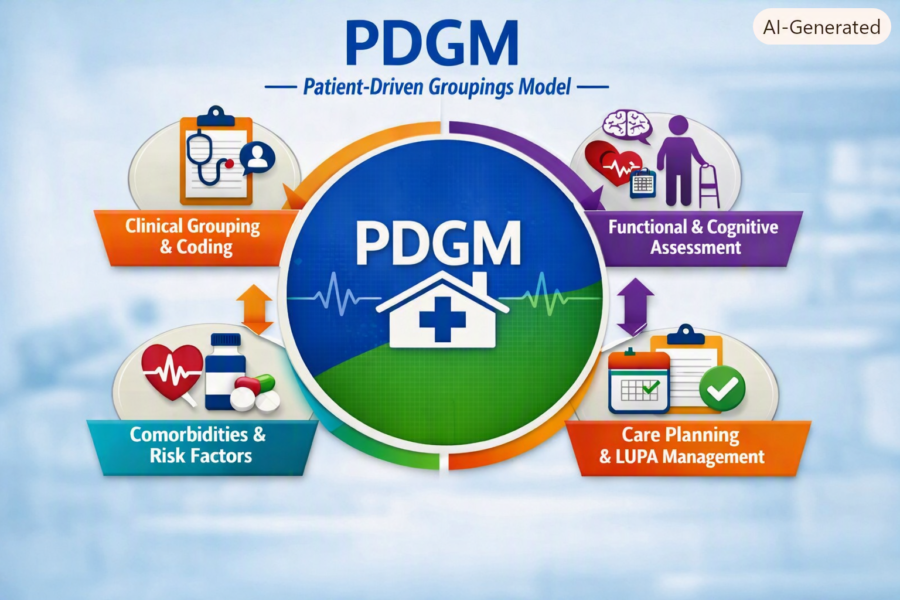
The Patient-Driven Groupings Model (PDGM) changed home health reimbursement by tying payment directly to patient characteristics, functional status, and clinical complexity — not therapy volume. With OASIS‑E now fully implemented, agencies must rely on precise assessment, correct coding, and accurate functional scoring to protect reimbursement and avoid unnecessary LUPAs.
For clinicians, this means one thing: Your OASIS‑E accuracy is the agency’s revenue protection strategy.
- Why PDGM and OASIS‑E Are Now Inseparable
PDGM uses five core components to determine payment:
- Admission Source (community vs. institutional)
- Timing (early vs. late)
- Clinical Grouping
- Functional Impairment Level
- Comorbidity Adjustment
PDGM Additional Information and Tip Sheet
OASIS‑E directly feeds three of these:
- Clinical grouping (diagnosis selection + coding accuracy)
- Functional impairment (mobility, ADLs, cognition)
- Comorbidity adjustment (secondary diagnoses)
If any of these are under‑documented or miscoded, PDGM reimbursement drops — even when the patient is clinically complex.
- OASIS‑E Items That Most Influence PDGM
These are the “high‑leverage” items where RN accuracy matters most:
- Functional Items (Mobility + ADLs)
These determine the Functional Impairment Level, which can swing payment significantly.
Key OASIS‑E items:
- GG0130 (Self-care)
- GG0170 (Mobility)
- M1800 series (ADLs/IADLs)
Under-scoring functional limitations = lower PDGM payment.
- Cognitive + Behavioral Items
These influence care planning and can justify comorbidity adjustments:
- B1300 (Cognitive function)
- B1400 (Memory/recall)
- B1500 (Behavioral symptoms)
- Diagnosis Coding (Primary + Secondary)
Your primary diagnosis determines the clinical grouping. Your secondary diagnoses determine comorbidity adjustment.
If the primary diagnosis is too vague or not PDGM‑eligible, reimbursement drops.
If secondary diagnoses are missing, the agency loses the comorbidity bump.
- The RN’s Role: Protecting PDGM Through Assessment Accuracy
As an RN with decades of home health experience, you already know this: The Start of Care RN sets the entire PDGM payment pathway.
Your SOC accuracy determines:
- The clinical group
- The functional impairment level
- The comorbidity adjustment
- The LUPA risk
- The care plan intensity
- The visit pattern
A single under‑documented functional item can reduce payment by hundreds of dollars.
A single missed comorbidity can eliminate the adjustment entirely.
- How OASIS‑E Accuracy Helps Avoid LUPAs
LUPA avoidance is NOT about “adding visits.” It’s about matching visit frequency to true patient need, which is only possible when OASIS‑E reflects the patient’s actual condition.
OASIS‑E items that strongly influence LUPA risk:
- GG0170 mobility limitations
- M1033 high-risk factors
- Pain interference (J0510–J0530)
- Dyspnea (M1400)
- Cognitive impairment (B1300)
- Medication management complexity (N0415)
When these items are accurately scored:
- The care plan naturally requires enough visits to avoid LUPA.
- The agency can justify the visit pattern to auditors.
- Clinicians aren’t pressured to “add visits” because the OASIS supports the need.
Accurate OASIS‑E = clinically justified visit frequency = natural LUPA avoidance.
Additional PDGM Tip and Information
- PDGM Pitfalls Agencies Still Struggle With
You can highlight these in your blog to position yourself as an expert:
- Undercoding secondary diagnoses
- Choosing a weak primary diagnosis
- Under-scoring functional limitations
- Not linking diagnoses to interventions
- Incomplete medication reconciliation
- Missing high-risk factors
- Poor documentation of pain, dyspnea, or mobility
Each of these directly affects PDGM payment and LUPA risk.
- How RNs Can Strengthen PDGM Outcomes
- Document the “why” behind every functional score
If the patient needs assistance, describe the barrier:
- Pain
- Weakness
- Dyspnea
- Cognitive impairment
- Safety concerns
- Endurance issues
- Link diagnoses to interventions
This protects both PDGM grouping and medical necessity.
- Capture ALL clinically relevant comorbidities
Especially:
- CHF
- COPD
- Diabetes
- Renal disease
- Neurologic disorders
- Wounds
- Behavioral health conditions
- Use OASIS‑E cognitive items to justify supervision needs
This supports visit frequency and reduces LUPA risk.
- PDGM + OASIS‑E: What Agencies Should Train For
You can turn this into a checklist or downloadable PDF later.
- Accurate functional scoring
- Correct diagnosis sequencing
- Comorbidity capture
- Linking interventions to diagnoses
- Pain and dyspnea documentation
- Medication complexity documentation
- High-risk factor identification
- Visit pattern justification
- LUPA risk identification at SOC
- Final Takeaway
PDGM rewards agencies that invest in clinical accuracy, not volume. OASIS‑E is now the backbone of reimbursement, care planning, and LUPA avoidance.
When RNs document the true clinical picture:
- PDGM payment aligns with patient complexity
- LUPAs naturally decrease
- Care plans become safer and more realistic
- Agencies stay compliant and financially stable
Your SOC accuracy is the agency’s strongest PDGM protection.
For additional Tips and Information on PDGM
Disclaimer
This article is for educational purposes only and not medical advice. Please consult a healthcare professional for any medical concerns. This article may contain links to products where there may be a charge for the information.
To see more articles — BHealthyRN.com
About the Author — Rhonda McElvany, RN, CRC, with over 30 years of experience in hospital inpatient, outpatient, data validation, and risk-adjustment coding, now enjoys writing about today’s healthcare issues and concerns.